

A senior reviewer retires in March. In June, an AI system trained on the department’s documentation flags a claim as clean and routes it for auto-approval. It shouldn’t have. The reviewer would have caught it in about four seconds, the same way she caught the last dozen like it. Not because a policy told her to. Because she’d seen this exact combination of vendor, timing, and dollar amount go wrong before.
Nothing in the file was wrong. What was missing was never in the file.
Here’s the question worth asking: who is on the hook when a system does exactly what it was told, using exactly what was written down, and still gets it wrong? Not the vendor. Not the reviewer, she’s retired. Nobody, really, which is the actual problem.
The knowledge that never got committed
Companies have absorbed senior departures for decades without much drama. A knowledge-transfer memo, a mentoring quarter, an exit interview that gets filed and never reopened again. Not a great system, but a survivable one, because the gap it left behind got absorbed by other humans. A newer colleague called the retired reviewer a few times, or got the judgment wrong three times before rebuilding it the expensive way. That cost was real, but it was private and diffuse, spread across one employee’s learning curve, and it never showed up as a line item anywhere.
An AI system doesn’t rebuild anything the expensive way. It has no way to know what it doesn’t know. It reads whatever was documented, treats that as the complete picture, and acts on it with total confidence. The gap that used to surface as a slow drip of minor human error now surfaces as a system making the same category of mistake at scale, instantly, correctly formatted, and confidently wrong.
That’s the actual shift. The retiring workforce isn’t new. What’s new is that the cost of the gap moved from slow and diffuse to fast and systemic, and nobody updated the org chart to reflect it.
The wave is bigger, and faster, than most succession plans assume
Start with the base rate. An independent economic study puts the retiring cohort at 30.4 million Americans between 2024 and 2030, enough that employers need roughly 240,000 new hires a month for five years just to hold the labor force where it is. Manufacturing, healthcare, utilities, and construction take the biggest hit.[1]
The headcount number is the boring part. What travels with each departure is harder to price. Harvard Business Review researchers Dorothy Leonard and Walter Swap have a useful term for it: “deep smarts,” the kind of judgment built by handling the same exception dozens of times, not by reading a policy once. One organization estimated that a coming wave of 700 retirements would cost it more than 27,000 years of accumulated experience.[2] Run that math across every mid-sized manufacturer or hospital system operating on a few decades of institutional memory, and you get a liability nobody is required to put on a balance sheet, which is exactly why nobody manages it like one.
Concern is not a plan
So why doesn’t documentation just fix this? It isn’t for lack of awareness.
78% of manufacturers say they’re concerned about the aging workforce.[3] That’s close to unanimous. What’s rare is anything downstream of the concern: in a survey of 1,500 retiring baby boomers, 57% said they left with less than half of what they knew documented anywhere, and 21% left nothing at all.[3] Only 18% felt they’d handed over everything.
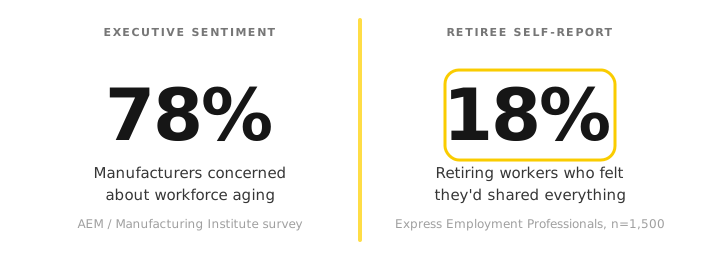
Two different surveys, measuring two different things: how worried executives are, and how much retirees actually handed over.
Those two numbers measure different things, executive sentiment against retiree self-report, which is exactly why they’re worth reading side by side. Worry is universal. Capture is rare. That gap isn’t a discipline problem. It’s an incentive problem: the person holding the knowledge has no real reason to fully externalize it. Nobody gets a bonus for making themselves replaceable, and the last quarter before retirement is not when most people volunteer for a rigorous debrief.
Think of it as a codebase where the load-bearing logic lives only in one engineer’s local working copy. It runs fine. Nobody ever ran git commit. When the laptop leaves the building, so does the only copy, and there’s no history to git blame your way back to. A wiki page or an exit interview is a README, at best. It was built to record what’s already explicit. It was never built to reconstruct a decision that was never written down in the first place, and the survey data above confirms it mostly doesn’t.
This isn’t HR’s problem. It’s an information problem with a deadline.
The instinct is to file this under succession planning and hand it to HR, next to the open headcount req. That’s a category error. This is an information problem that happens to be triggered by a personnel event.
Every AI use case that depends on one person’s judgment, the escalation call nobody wrote a rule for, the “we don’t actually do it that way anymore even though the doc still says so,” loses its ground truth the day that person walks out, and nothing announces it. The system doesn’t get worse everywhere. It gets worse exactly in the cases that mattered most, which happen to be the cases a generic retrieval pipeline was least equipped to handle to begin with.
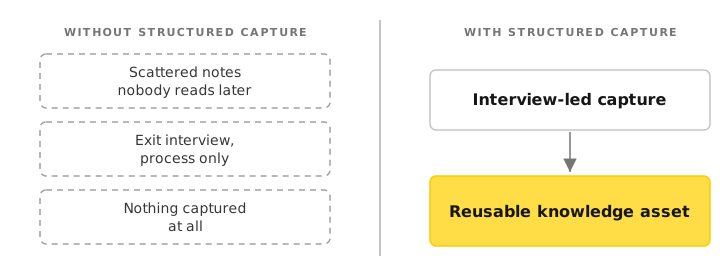
Without structured capture, judgment scatters three different ways. With it, there's exactly one asset to point an AI system at.
Framed as HR’s problem, this sits on a spreadsheet, waiting on a mentoring program that may or may not happen before the retirement date arrives. Framed correctly, it’s a line on the AI roadmap with an actual deadline attached to it: the date on the calendar.
The fix isn’t a better wiki
Wikis capture what someone can describe in the abstract. The judgment that prevents the bad approval isn’t abstract. It’s a reaction to a specific case, and getting at it requires someone in the room asking the follow-up question: why did you flag that one, and not the one right before it that looked almost identical?
That’s an interviewing problem, not a documentation problem, and unlike most infrastructure decisions, it comes with an actual deadline. At Clarifeye, that’s the specific mechanism Clara is built to run: document-aware interviews that ask the follow-up question a generic exit survey never will, turned into something structured enough for a system to use later, not just a transcript someone has to reread and reconstruct.
The retirement date on your org chart isn’t a scheduling problem. It’s a deadline on how much longer a specific piece of institutional judgment is still interviewable. Most companies have a plan for the first kind of deadline and nothing for the second. The more useful question isn’t when someone is retiring. It’s which of your AI systems is quietly depending on them anyway, and how you’d find out before it fails.
Sources
- Robert J. Shapiro & Luke Stuttgen, “The Peak Boomers Impact Study,” Alliance for Lifetime Income / Retirement Income Institute, April 2024.
- Dorothy Leonard & Walter Swap, “What’s Lost When Experts Retire,” Harvard Business Review, December 2014.
- The Manufacturing Institute / Association of Equipment Manufacturers, “The Aging Workforce: 4 Ways Manufacturers Can Prepare Themselves,” 2022 (citing an Express Employment Professionals survey of 1,500 baby boomers).