

A Chief AI’s team can build twelve AI skills this quarter and still be moving the company away from its own strategy. A support-ticket triager. A contract redliner. A sales-call summarizer. Every one of them works. Every one of them passes its demo. Nobody in the room ever checked whether the twelve of them, together, still point at the AI strategy the company signed off on two years ago, because nothing in how any single one of them got built was ever pointed at that question.
AI skills are tactics. A knowledge store is a strategy. You build skills from the knowledge store. You do not build a strategy from skills, and that direction does not reverse, no matter how many skills you build or how well each one works.
Every AI skill is a local hill-climb
There is a name for what happens when you optimize the piece in front of you without checking it against the whole. Economists and operations researchers call it sub-optimization. Charles Hitch wrote the original paper in 1953, decades before anyone had an AI skill to worry about. His point was plain: you sub-optimize because you cannot compute the real, top-level objective in the moment, so you optimize against whatever local yardstick you happen to have instead.
That is not a failure of effort. It is what happens by default, every time, when a part gets judged only on its own terms.
Daniel Levinthal modeled this directly in 1997, using what management scientists call a rugged landscape: performance as a landscape of hills, searched by hill-climbing. Try something, keep it if it works better, try the next thing from there. Climb long enough and you reach a peak. The problem is you reach whichever peak happens to be nearest to where you started, not the tallest one on the map, and hill-climbing gives you no way to tell the difference from where you are standing.
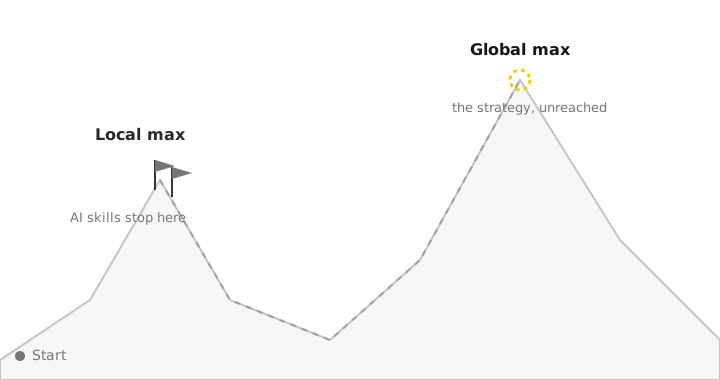 Figure: The nearest hill isn’t the mountain. Optimizing skill by skill finds the closest peak, not the tallest one.
Twelve AI skills built by twelve different owners are twelve of these local climbs. Each one gets measured against its own ticket queue, its own contract backlog, its own call volume. None of them get measured against the strategy, because nobody ever handed the owner a version of the strategy they could check their skill against. That is not a problem you fix with a better meeting. It is what happens when the one thing that is supposed to hold the whole picture does not exist yet.
Every AI skill your team builds is one of these local climbs. It gets tuned and turned loose on the hill directly in front of it: the ticket queue, or the contract backlog, or whatever is closest. It can climb that hill perfectly and still never come near the taller peak sitting a mile over, the one the strategy was actually supposed to reach. The worst part is that a local peak looks exactly like a peak from where you are standing on it. Winning the local climb tells you nothing about whether there was a taller one you missed.
Operational effectiveness was never strategy
Michael Porter made almost the same point about business strategy in 1996, from the opposite direction. Doing one activity well, he wrote, is operational effectiveness. It is real, it is necessary, and it is not strategy. Strategy is fit: how the activities work together, a chain that is only as strong as its weakest link. An AI skill that works is operational effectiveness. It is the local hill, climbed well. On its own, it was never going to be the strategy, no matter how well it worked.
It gets worse than simply not helping. Paul Milgrom and John Roberts showed in 1995 that organizational practices are complements, not independent moves. Adopt one practice in isolation and you do not just fail to gain from it. You can end up worse off, because the practice was only ever meant to work alongside the others it depends on. Bolt one AI skill onto a workflow with no shared knowledge store behind it, and you have not added a small win. You have added a piece that is now free to pull against everything else.
A pattern isn’t a strategy
A strategy does not have to be the plan someone wrote down in advance. It can just as easily be the pattern that falls out of everything a company actually did, chosen or not. It is tempting to use that idea to let skill-first off the hook: build enough tactics, and the pattern that falls out is itself a strategy.
It is not, for the reason from the last section. A pattern nobody derived from the full picture never had access to the thing that would have made it a real strategy in the first place. It is an accident wearing the shape of intent, and it looks convincing right up until it stops working. Every AI skill built without reference to a shared knowledge store adds to that same accident, one local decision at a time, at the level of a whole AI portfolio instead of one team and one skill.
The tighter the fit, the harder it is to notice
A system of AI skills that fit together well internally can keep looking like a win for a long time after the world around it has already changed, because every signal you are checking is a signal from inside the system you built. The tighter the local fit, the harder it becomes to see that the ground has moved, because nothing inside the system was ever set up to notice it.
A portfolio of well-built AI skills, all locally coherent, all landing on schedule, is the same trap. The better each individual skill looks, the longer it takes anyone to notice the portfolio was never pointed anywhere in particular.
Build the knowledge store first
A knowledge store is a strategy, not a place where you store one that was written down somewhere else. It is the thing that holds the whole picture: the context, the exceptions, the judgment calls that never made it onto a slide. An AI skill derived from it inherits that picture instead of inventing its own. That is the only fix that runs in the right direction: build the knowledge store first, and let the skills come from it, not the other way around.
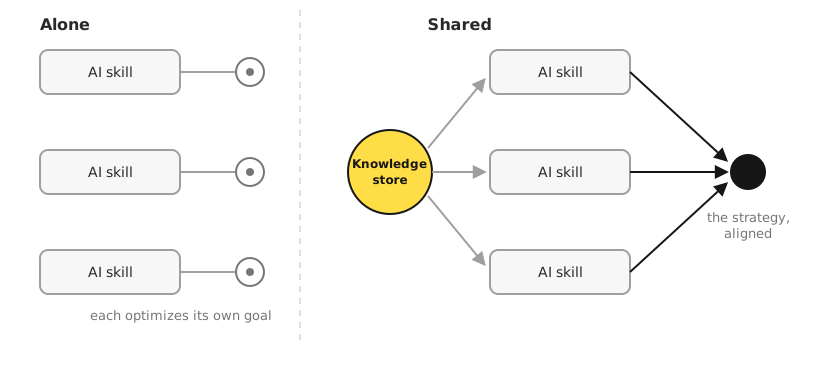 Figure: Optimizing against a shared objective, instead of your own. Skills derived from one knowledge store are measured against the same goal. Skills built alone are measured against whatever goal they happened to assume.
We have made adjacent versions of this argument before, from different angles. Skill Island is about whether a skill’s captured judgment survives moving to a new tool, a portability problem. From Data as Oil to Logic as Gold is the broader claim that operationalized judgment, not raw data, is the asset that matters now. This is the version of the problem that shows up once you have both: skills with real judgment in them, derived from a real knowledge store, still need to be checked against the strategy, because a local peak and a global one were never the same axis to begin with.
Sub-optimization is what happens by default. It is not a rounding error, and it does not announce itself. The fix only runs one direction. The knowledge store comes first, and the skills come from it.