

I was talking with a good friend at NVIDIA the other day about “Capture the Unwritten” (the piece we wrote on unwritten operating knowledge as the missing enterprise asset). Partway through, he mentioned he’s about to spend the next few months covering for a colleague who’s going out on leave. Not shadowing for a week. A real handoff: absorbing everything that colleague has learned, fast enough that the work doesn’t stall while they’re gone.
That’s the exact same problem we’d just spent twenty minutes talking about. It just landed on his desk instead of staying theoretical.
I mentioned it to Arthur, since capturing exactly this kind of knowledge is what he does for a living. Turns out he’d just put together a walkthrough of the real workflow. Not a mockup. The actual thing Clarifeye runs when someone needs to capture what a departing person knows before the work lands on someone else’s desk.
Watch: the expert-offboarding workflow
Arthur's walkthrough of the expert-offboarding workflow: interview the person before they leave, structure what comes out, hand the covering colleague something they can actually use.
Watch enough of these and the pattern is obvious: the goal was never a transcript. The point is giving the colleague picking up the work a way to replicate the departing person’s reasoning: not just a list of what they do, but why they’d make one call and not another when two situations look almost identical. A transcript records what was said. Reasoning is what lets someone else get the same case right the next time.
A wiki page can’t ask the follow-up question
A Confluence doc, a wiki page, a “here’s what you need to know” email: these capture what someone can describe in the abstract, sitting at a keyboard with no specific case in front of them. The judgment that actually matters usually isn’t abstract. It’s a reaction to something concrete: why did you route that ticket to the senior team and not the one that looked almost the same?
Getting that out of someone’s head takes someone else asking the follow-up question, in the moment, against a real case, not a template with blanks to fill in. That’s an interview problem, and it’s the specific thing Clara is built to run: sit down with the departing person before they leave, ask the questions a generic handoff doc never asks, and turn the answers into something structured enough for the covering colleague (or an AI system) to actually use, not a transcript someone has to reread and reverse-engineer later.
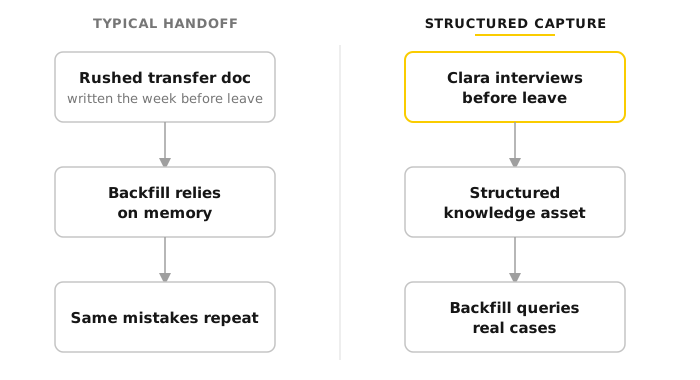
Two ways to run the same handoff: one relies on memory, the other on a structured asset.
The gap is temporary, but the work doesn’t pause
We’ve written before about what happens when a senior expert retires and takes years of judgment out the door with them. Employee leave is a different animal, but it rhymes. The person isn’t gone for good. They’re gone for four months, or six, and during that window every judgment call that used to run through them has to run through someone else, someone who almost certainly hasn’t seen the fifteen edge cases that made the original person fast and right.
The company’s instinct is usually a knowledge-transfer doc, written in the two weeks before leave starts, on top of wrapping up existing work, on top of everything else that comes with someone’s life changing. It’s the worst possible moment to ask someone to sit down and externalize years of judgment cleanly. It gets done badly, or partially, or not at all, and the person covering spends the next few months making the same mistakes the departing person stopped making a long time ago.
Unlike a retirement, this isn’t a once-a-career event for the organization. People take leave constantly: parental leave, medical leave, sabbaticals, a few weeks caring for a parent. It’s a recurring gap, and most companies handle it the same ad hoc way every single time.
Plan for it like you’d plan for coverage
Most teams already plan around a known absence: who’s covering whose meetings, who owns which ticket queue while someone’s out. Almost none of them plan for the judgment gap the same way, because it’s never been treated as a solvable, schedulable thing. It’s been treated as an unfortunate cost of someone being human and having a life outside of work.
It doesn’t have to be. If you know someone is going on leave in six weeks, that’s six weeks of lead time to run a structured capture, not a rushed one written under deadline pressure the week before they go. The person covering gets something they can actually query against real cases, not a document they skim once and then wing it from memory. And the person going on leave gets to leave without spending their last two weeks anxious about everything that’s still only in their head.
My friend at NVIDIA is going to be fine. He’s sharp, and from what he described, this handoff is already going better than most. But the fact that a two-minute aside about capturing unwritten knowledge turned into “oh, that’s literally what I’m dealing with right now” tells you something: this isn’t hypothetical. Somebody on your team is covering for a colleague this week, trying to reconstruct judgment nobody wrote down, and most companies still treat that as bad luck instead of a solvable problem.
If that’s you, or you want to see how the capture side works before your next handoff, I’d like to hear about it. Email me at [email protected], or grab time on my calendar.